
- Sapporo Brewery and Sales
- Founded in 1876 / Public sales began in 1877
- Yebisu and the Station
- Beer launched in 1890 / Freight station opened in 1901
- Super Dry Launch
- 1987
- Minimum Volume for a Beer License
- Reduced from 2,000 kL to 60 kL in 1994
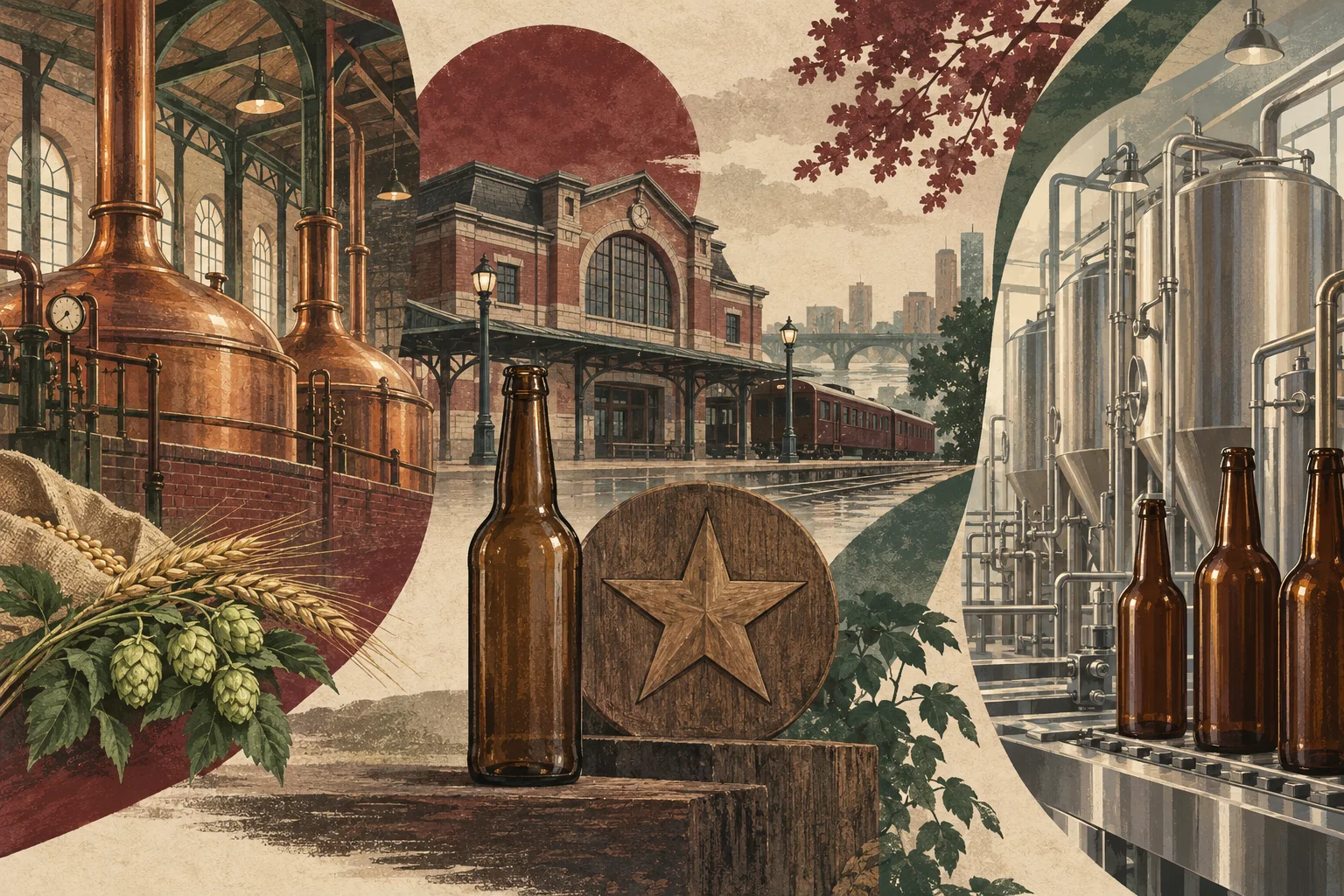
Japanese beer grew into a factory industry through demand from foreigners in treaty ports and the Meiji government's efforts to develop industry. The star on the label recalls the beginnings of a government brewery, while the place name Ebisu preserves a trace of beer transport. This history offers a way to look at familiar brands beyond rankings of their taste.
Key point Separating brewery founding dates from product launches, and tracing how label symbols and urban place names arose, lets us read Japanese beer as a history of industry and design.
What to notice
- Commercial brewing in Japan had distinct beginnings in foreign businesses in Yokohama and government enterprise in Hokkaido.
- Company, brewery, and brand dates need to be distinguished, as with the founding of the Sapporo brewery in 1876 and the start of product sales in 1877.
- The red star of Sapporo Lager and the station name Ebisu preserve traces of the Kaitakushi and beer transport, respectively.
- Dry beer competition and liquor tax rules changed product names, but they do not tell us how early beers tasted.
Beer Was Known Before the Meiji Era
Dating Japan's first encounter with beer to the arrival of Perry's fleet overlooks earlier records. Kirin's historical materials describe a British ship's cargo list from 1613 and a record of Japanese people drinking beer through contact with the Dutch in 1724. In 1812, Hendrik Doeff, head of the Dutch trading post at Dejima, is said to have attempted brewing. These encounters and experiments differed from later factory production in both scale and purpose.
A record of a shipboard banquet after treaty negotiations with Perry's fleet in 1854 mentions a frothy alcoholic drink. Kirin suggests it was beer. We cannot identify the recorded drink as confidently as a modern product, and there is insufficient evidence to call Perry the first person to introduce beer. It is more accurate to distinguish the history of encounters with beer from the emergence of a beer industry.
Demand in Yokohama, a Brewery in Hokkaido
A foreign settlement developed in Yokohama after the port opened. William Copeland opened the Spring Valley Brewery in 1870 to serve this demand. The date 1869 belongs to a different brewery, the Japan Yokohama Brewery. Spring Valley made several styles, including ale, porter, and lager. This is one reason Japan's brewing beginnings cannot be explained through a single German style.
Sapporo's beginnings involved a government project. The Meiji government's Kaitakushi opened a brewery in 1876 as part of its work to establish industries in Hokkaido. The Kaitakushi was the government agency responsible for developing Hokkaido at the time. Private enterprise in a treaty port and government industrial development thus fostered brewing through different routes. There is no need to characterize the project as a plan to eliminate sake, or as a business that never competed with sake at all.
How Did Brewing Skills Learned in Germany Reach Sapporo?
Seibei Nakagawa, known as the brewing specialist behind Sapporo, did not initially go to Germany as a government-sponsored student. He left Japan in 1865, when overseas travel was prohibited, learned brewing in Germany, and returned in 1875. The official materials consulted record his training at a brewery in Berlin. The skills he acquired abroad became part of the Kaitakushi's project the following year.
Lager is beer fermented and matured at relatively low temperatures. Before modern cooling equipment was widely available, ways to keep it cold mattered. The Kaitakushi's brewing plans mention securing natural ice and experimentally growing barley and hops. There is also a record of wild hops being found in Hokkaido. These specific, documented conditions explain the brewery's location better than a broad claim that every part of Hokkaido was more suited to barley than rice.
Whose Birthday Does the Year on a Label Mark?
Sapporo distinguishes the founding of its brewery in 1876 from the start of public sales of Sapporo Beer in 1877. The product its official introduction describes as the oldest surviving Japanese beer brand is Sapporo Lager, whose roots date to 1877. Extending that description to a ranking of companies or to Japan's first brewery would leave out Yokohama's earlier history.
Spring Valley is a root of the business that led to Kirin. In Kirin's history, the establishment of Japan Brewery in 1885, the launch of Kirin Beer in 1888, and the founding of Kirin Brewery Company in 1907 are separate events. Yebisu Beer launched in 1890 through a predecessor company founded in 1887. Asahi, too, launched Asahi Beer in 1892 after Osaka Beer Company was founded in 1889. Lining up different kinds of dates changes the answer to which brand is oldest.
Do Sapporo's Stars Share the Same Color and Meaning?
The red five-pointed star on Sapporo Lager carries on the North Star symbol used by the Kaitakushi. An emblem of the agency responsible for northern development survived as a product identifier. Remembering only the star's shape can lead us to group several Sapporo products under one design. But the nickname Akaboshi, meaning red star, should be associated specifically with Sapporo Lager.
Other Sapporo products also feature gold stars. The shared star shape and the color used for each product are distinct features. If you see a red star, look at the product name and label description together. If the star is another color, check which product uses it. Separating the symbol's history from current packaging design helps avoid explaining an entire company through a single color.
Ebisu Is a Place Name That Grew Out of a Beer Name
Tokyo's Ebisu reverses the familiar pattern of a beer taking the name of an existing neighborhood. A freight station opened in 1901 to transport Yebisu Beer, which had launched in 1890, and the station was named Ebisu. When it began serving passengers in 1906, residents and visitors also came to use the name. A railway carrying a product's name became a place name used by people coming and going.
Ebisudori became an official place name in 1928, while the present Ebisu 1 through 4 chome took shape through a place-name reorganization in 1966. The beer launch, station opening, and establishment of the neighborhood name were therefore separate events. A name on a map can invite us to ask what nearby facilities once transported. Here, the brewery and station that shipped beer reveal that connection.
Beer Halls Brought Beer Beyond the Brewery
A beer hall serving Yebisu opened in Tokyo's Ginza district in 1899. Sapporo's official history presents it as Japan's first beer hall. That claim of being first should be read within the history of beer halls. A 500-milliliter glass cost 10 sen, which was not cheap for ordinary people. Nor can the opening alone be taken to mean beer had already become widely accessible. The claim does not imply that there had previously been nowhere in Japan to drink beer, or that today's company drinking-party culture was invented there.
Beer halls offer a way to consider how beer moved beyond brewing and bottling. Product names appeared on street signs, and groups of people encountered beer in the same place. Western-style food and urban dining culture provide further context. This article, however, does not cover evidence that would establish that particular beer and food pairings spread at the same pace nationwide.
Mergers and War Changed the Names on Labels
In 1906, Sapporo, Japan Beer, and Osaka Beer merged to form Dai Nippon Beer. The familiar names Sapporo, Yebisu, and Asahi thus spent a period under one company. Kirin was not part of this merger. During wartime in 1943, individual brand names were replaced by a unified label reading simply Beer. This did not mean beer itself was banned outright. Changes in bottle names cannot be explained solely by advertising tastes; they also need to be read in the context of industrial controls at the time.
In 1949, Dai Nippon Beer split into Asahi Breweries and Nippon Breweries. The legal basis was the Act for the Elimination of Excessive Concentration of Economic Power, a postwar law intended to reduce the concentration of economic power in particular companies. The Sapporo brand returned in Hokkaido in 1956 and began nationwide sales in 1957. Separately, Nippon Breweries changed its company name to Sapporo Breweries in 1964. Applying today's company name directly to older labels obscures these intervening steps. This is why the producer name, brand name, and date of a label should be checked together.
In 1987, Dry Became a Competitive Way to Describe Taste
Asahi launched Super Dry in 1987. Kirin, Suntory, and Sapporo followed with dry products in 1988, sparking the so-called dry wars. Asahi describes dry taste as having little sweetness and a clean finish. On products, the word dry conveys this impression of flavor. Promoting a taste characteristic through a short word on the front of the package became central to competition.
Yet the success of one product cannot be explained as the result of all Japanese consumers changing their tastes at once. Advertising, distribution, and conditions at the point of sale influence choices alongside flavor. Launch dates and companies' descriptions of their products can be verified, but identifying a single cause of market changes at the time requires separate analysis.
Small Breweries and Taxes Changed Product Categories
In 1994, Japan reduced the minimum annual production volume required for a beer manufacturing license from 2,000 kiloliters to 60 kiloliters. Sixty kiloliters is 60,000 liters. The lower threshold made it easier for small breweries to qualify, creating regulatory conditions for more local beers. Distinguishing large companies' national brands from local breweries also helps explain why Japanese beer today is difficult to group into a single style.
Liquor tax rules have shaped the names happoshu and third-category beer. Happoshu is a category distinguished from beer by legal conditions such as malt proportion, while third-category beer was a common name used for a time. These products cannot all be treated as one legal category. Manufacturers introduced products with different ingredients and production methods, and differences in tax rates at the time helped explain their prices. In October 2023, new-genre products were incorporated into the happoshu category. By this article's verification date, October 10, 2026, tax rates had already changed. From October 1, 2026, the basic liquor tax rates for beer and happoshu were unified at 155,000 yen per kiloliter. This is a liquor tax rate, not a retail price, and consumption tax is separate.
What Old Labels Can and Cannot Tell Us
Stars, place names, and company names on labels reveal connections among agencies, breweries, and railways. But they cannot by themselves reconstruct the taste of 19th-century beer. Nakagawa's training in Germany does not prove that beer of the period was the same as today's Munich-style dunkel. Descriptions claiming that all early beers were golden or amber, with bread and caramel aromas, or strong malt and hop flavors and a cloudy, heavy body have not been verified. Comparative evidence is also lacking for claims of weak carbonation, coarse foam, or large differences in taste between batches. Saying that all early Japanese drinkers disliked beer because of its bitterness is similarly too sweeping. Records also include favorable responses to products and requests for sales in foreign settlements.
Filtration and pasteurization likewise need to be examined by period and brewery. Sapporo's official chronology records the launch of pasteurized Sapporo Lager in 1888. Describing all Meiji-era beer as unpasteurized conflicts with this record. Conversely, today's heat-treated product does not allow us to infer that the first product in 1877 was also pasteurized. Nor is there a basis for presenting modern beers, including today's dunkel from Otaru, as exact recreations of early Meiji-era flavors.
The criteria used to assess draft beer today are also distinct from evidence of historical flavor. Storage temperature, equipment cleaning, care of lines and glasses, and gas pressure suited to the temperature matter when evaluating serving quality. Major brewers provide cleaning and handling guidelines and training for venues. The existence of these guidelines does not establish that every venue serves beer in the same condition. When taking notes on labels, record visible colors and names, verified dates, and flavors still unknown as separate items. You can explore this history through official archives and maps without drinking alcohol.
Notes
- Official company histories explain the histories of their own breweries and brands. Claims such as first or longest-established have been read with attention to the subject and scope of each source.
- Modern products are not treated as recreations of early beer's color, aroma, or carbonation. Product classifications and tax rates may change depending on when they are checked.
Sources
Sources consulted for this article.
- Kirin History Museum: Beer Before the Meiji Era
- Kirin History Museum: Experimental Brewing at Dejima
- Kirin History Museum: Records of the Banquet with Perry's Fleet
- Kirin History Museum: Breweries in Yokohama
- Kirin Official History: Company and Brand Chronology
- Sapporo Official History: The Kaitakushi Brewery
- Nagaoka City: Seibei Nakagawa
- Sapporo: Nakagawa's Training and Brewing Plans
- Sapporo: The History of Hop Cultivation
- Sapporo Lager: The Red Star and the Brand's History
- Yebisu Official History: The Connection Between Beer and the Place Name
- Asahi Official History
- Sapporo: The Opening of the Ginza Beer Hall
- Sapporo: War and Brand Labels
- Sapporo Official Chronology: Merger, Pasteurization, and the Brand's Return
- Kirin History Museum: Dry Beer Competition
- Asahi: Describing Dry Taste
- Japan National Tax Agency: Local Beer and Manufacturing Licenses
- Suntory: The History of Happoshu Development
- Japan National Tax Agency: Liquor Tax Rules and Product Development
- Asahi: Incorporation of New-Genre Products into Happoshu
- Japan National Tax Agency: Liquor Tax Rates Effective October 2026
- Sapporo: Draft Beer Handling Guidelines for Venues