
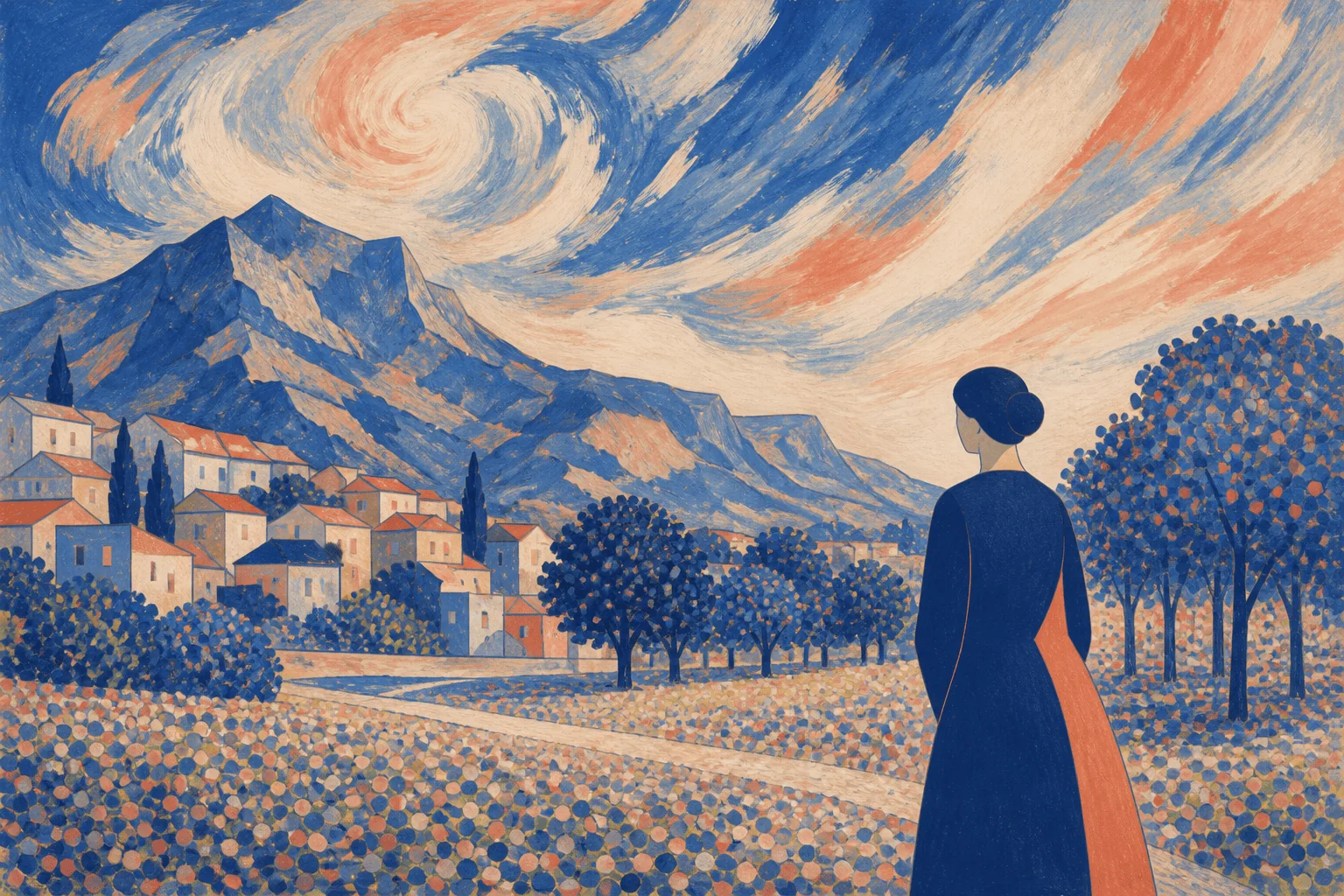
In the galleries after Impressionism, a park built from dots, a mountain assembled with firm planes, a sky trembling in intense color, and a flat symbolic figure may appear together. These are not one successor style. They begin with different questions about why a moment of light was not enough.
Key point Neo-Impressionism sought to handle effects of light and color more systematically. Post-Impressionism is a later, broad label for artists who pushed structure, expression, and symbolism in different directions.
What to notice
- Distinguish Divisionism from Pointillism to read the color experiments of Seurat and Signac.
- Compare what Cézanne, Gauguin, and Van Gogh added to a momentary impression.
- Include Armand Guillaumin and Henri-Edmond Cross to look beyond the familiar names after Impressionism.
Seurat treated light as a problem that could be calculated
In 1886 Georges Seurat showed A Sunday on La Grande Jatte at the final Impressionist exhibition. Studying complementary colors and contrast, he developed Divisionism, placing small marks of color separately. Up close, dots and short touches remain visible; from farther away, the eye combines them into a brighter, vibrating scene.
Pointillism is a characteristic brushwork method within Divisionism. In other words, “placing paint side by side without mixing it” describes the stricter experiment of Neo-Impressionism well, but it was not a common rule for every Impressionist. The critic Félix Fénéon helped establish the name Neo-Impressionism for this current.
Signac and Cross enlarged dots into fields of color
After Seurat, Paul Signac carried forward the theory and practice of Divisionism. In his later work, he used longer, mosaic-like color touches rather than very small dots, composing the light of seas and harbors more freely. It is more precise to say that he strengthened color as an independent force in a representational picture than to say that he began abstraction.
Henri-Edmond Cross also shifted Neo-Impressionist color toward broader, vivid marks. His art disappears if it is reduced to an anecdote about illness. In his canvases, sunlight in southern France becomes clear fields of color, and Pointillism already opens toward the color experiments of the next generation.
Cézanne built pictorial structure rather than a passing instant
Paul Cézanne did not end nature with a momentary impression. Through repeated observation, he built mountains, apples, and tables from relationships among planes and colors. These are not merely simple geometry; they are surfaces and colors that press against and support one another across the canvas.
In a 1904 letter to Émile Bernard, Cézanne summarized this concern by advising that nature be treated through relationships of the cylinder, sphere, and cone. The phrase “father of modern art” compresses his influence but cannot replace looking at the paintings. His structural pictures were an important stimulus for later Cubism and Fauvism, yet his aim was less to break objects apart than to keep a picture standing amid shifting visual experience.
Gauguin and Van Gogh changed how feeling could enter a picture
Paul Gauguin did not follow observed color literally when memory, imagination, and symbolism required another choice. Broad, flat color and simplified outlines turn a scene from a window onto reality into a surface where thought and feeling can remain. Explaining this as a vague praise of “primitivism” repeats a colonial gaze; it is better to consider Gauguin’s choices together with their historical context.
Vincent van Gogh left tension and rhythm in landscapes and figures through high-chroma color and repeated brushstrokes. Rather than using the label “painter of the soul,” look at how color and brushwork move the viewer’s senses.
Do not read Guillaumin only through the lottery story
Armand Guillaumin participated in the early Impressionist exhibitions. After winning the lottery in 1891, he could reduce wage work and devote himself more fully to painting. The anecdote is engaging, but it cannot stand in for the strongly colored landscapes and light around the Seine that he made.
The story after Impressionism does not close with a few famous masters. Looking at less familiar painters such as Guillaumin and Cross shows that experiments with light and color continued through varied working conditions and choices, rather than through one formula for success.
A way to distinguish three directions while looking
When an arrangement of dots and complementary colors is most visible, begin with the color experiments of Seurat and Signac. When interlocking planes of color and form come first, think of Cézanne’s structure. When intense colors unlike nature, flat outlines, or emotionally charged brushwork lead the image, you are closer to questions of expression raised by Gauguin or Van Gogh.
These distinctions are not a correct answer for putting artists into boxes. They are a starting point for asking, in front of a painting after Impressionism: was the artist trying to make light more exact, the picture more stable, or feeling more forceful?
Sources
Sources consulted for this article.