
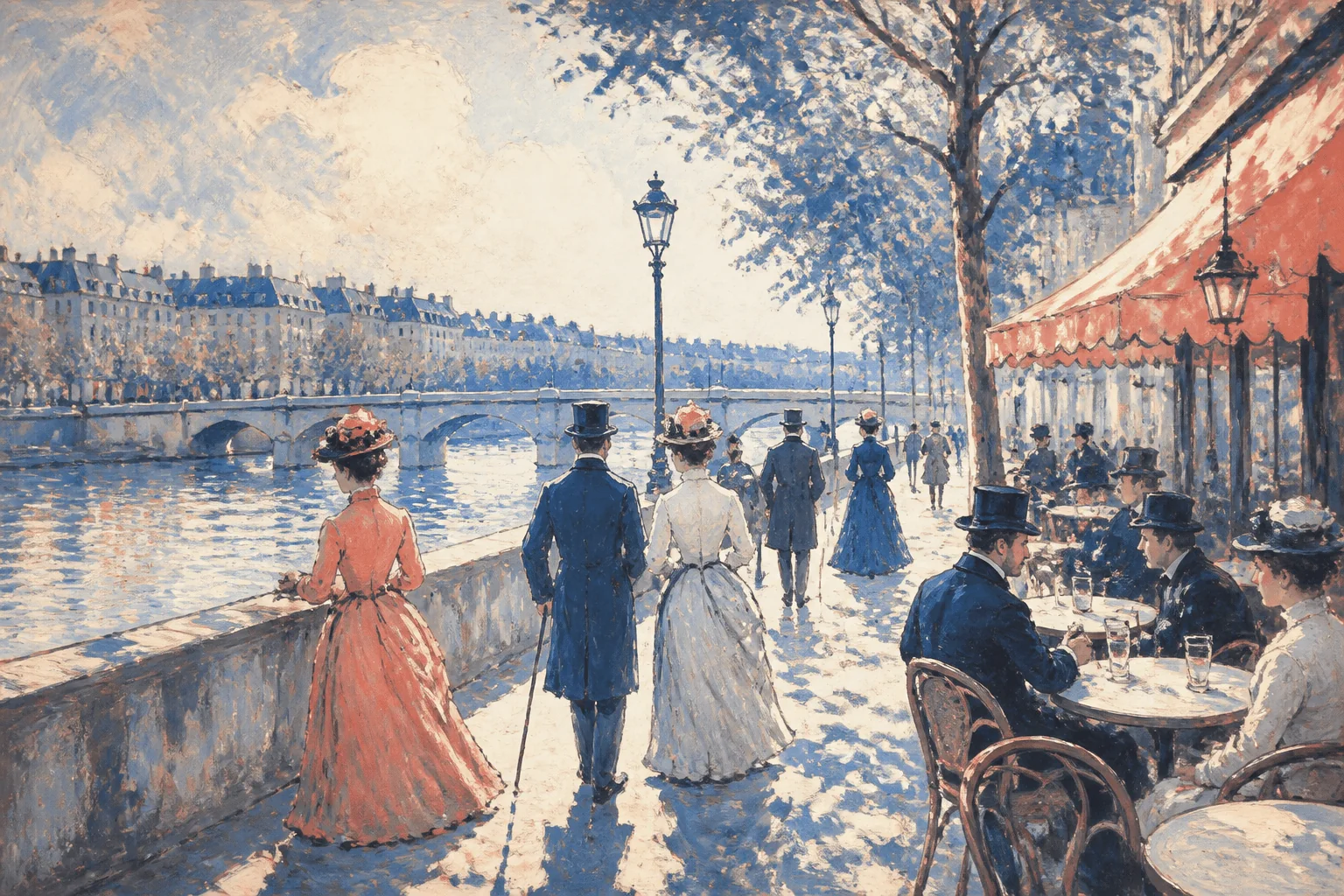
Up close, an Impressionist painting can leave short brushstrokes and distinct colors visible. A few steps back, light, water, and air join into one scene. That way of looking captures something essential, but it does not mean every Impressionist used the same method.
Key point Impressionism was a loose alliance of artists who moved away from fixed outlines and the hierarchy of history painting, placing directly observed light, color, and fleeting visual experience from modern city life and nature at the center of the canvas.
What to notice
- Separate the forerunners of Impressionism from Monet’s early work outdoors.
- See why the first independent exhibition took place in 1874 and how the name “Impressionism” began.
- Use changes in viewing distance to understand why the surface reads differently up close and from afar.
Questions had been gathering before 1874
J. M. W. Turner’s late landscapes pushed toward scenes in which form loosens in mist and light. Jean-François Millet made agricultural labor a subject for large-scale painting, and Vincent van Gogh later studied and admired his work closely. After being excluded from the official Exposition Universelle in 1855, Gustave Courbet opened his own Pavilion of Realism, creating an important precedent for exhibiting outside the institution.
They did not create Impressionism directly. They did, however, make the light of landscape, the lives of ordinary people, and a painter’s distance from artistic institutions into new questions. The Impressionists carried those questions into outdoor observation and independent exhibitions.
For Monet, outdoor light became a way of working
Eugène Boudin was an early mentor who encouraged the young Monet to paint by the sea and watch changes in the sky directly. Monet and his peers quickly placed colors observed over short periods outdoors. Paint tubes and rail travel expanded the conditions for this work, but they do not mean every painting was completed on site.
The Impressionists’ short strokes and adjacent colors were among several choices for suggesting flickering light. Never mixing paint on the palette was neither a strict rule nor a shared method of every Impressionist. The systematic separation of tiny color marks so that they combine in the eye became clearer later in Neo-Impressionism.
Not a rebellion that abandoned the Salon, but an exhibition seeking independence
On 15 April 1874, around thirty artists held their first independent exhibition at Nadar’s photographic studio, 35 boulevard des Capucines in Paris. With roughly two hundred works on view, it sought a way to show and sell art outside the official Salon’s jury and prizes. Not every participant had been rejected by the Salon, and not every one broke with it completely.
Monet exhibited Impression, Sunrise, painted in 1872. Critic Louis Leroy used its title mockingly when he called the artists “Impressionists”; the word born as a slight eventually became their name. In that sense, 1874 was less the day a style appeared overnight than the year a loose group acquired a public name.
Manet opened a door, but he was not a member of the exhibitions
Édouard Manet’s Luncheon on the Grass was rejected by the official Salon in 1863 and shown at the Salon des Refusés, where it caused major controversy. Its modern subject, unsettling gaze, and apparently flat surface gave younger artists a powerful stimulus.
Manet never exhibited in an Impressionist exhibition and continued to seek recognition at the official Salon. It is more accurate to see him as a forerunner who exchanged influence with the group while choosing a different exhibition strategy, rather than as a core member of the Impressionists.
At the museum, change your distance
First move close enough to see the direction of the brushwork and the places where separate colors touch. Then step back two or three paces and look for the point at which color and form join into light. Canvas sizes and ideal viewing distances vary, so “near and far” is a method of observation rather than a single correct answer.
Overwhelmingly large canvases are not an Impressionist trait in themselves. The thickness of paint and roughness of surface also vary by work. Moving back and forth lets you see material and the speed of the hand up close, then light and space from farther away.
Sources
Sources consulted for this article.