
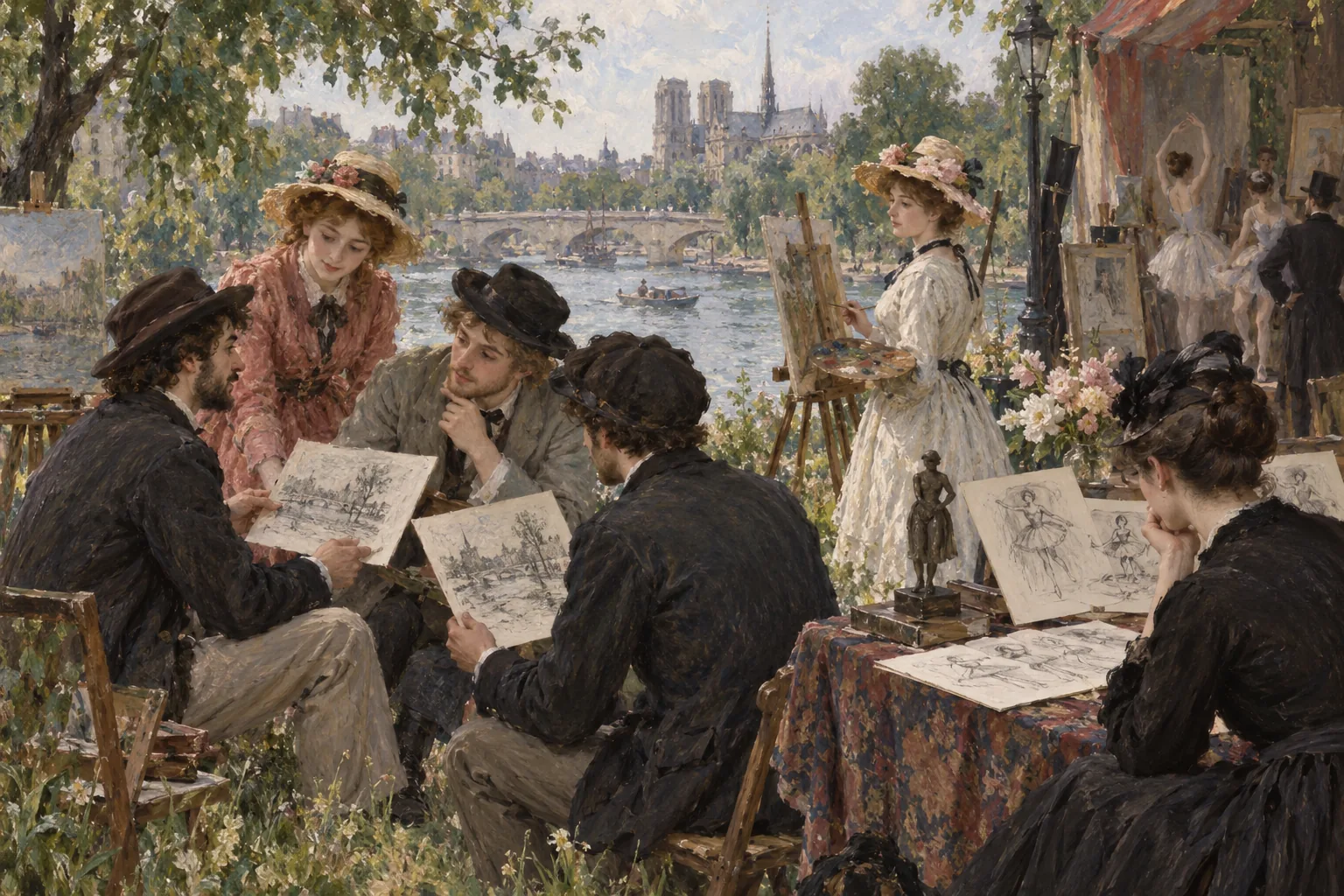
If Impressionism is memorized as one style, it is hard to explain why Monet’s landscapes, Degas’s backstage scenes, and Morisot’s interiors appeared in the same exhibitions. The artists were linked less by a shared manifesto than by relationships in which they organized exhibitions and supported each other’s work.
Key point The Impressionists were not a tightly unified group with one style. They were an alliance of peers who shared the need to show work outside the official Salon while pursuing landscape, city life, figures, and exhibition-making in very different ways.
What to notice
- Meet the early connection formed by Monet, Renoir, Sisley, and Bazille at Gleyre’s studio.
- Compare Monet and Renoir at La Grenouillère, and Degas’s view of the exhibition.
- See how Morisot and Cassatt, Caillebotte and Pissarro sustained this alliance.
Four friends from Gleyre’s studio
In the 1860s, Claude Monet, Pierre-Auguste Renoir, Alfred Sisley, and Frédéric Bazille met in Charles Gleyre’s studio. They went outdoors together to observe light and scenes of everyday life, forming an early connection that later helped make the independent exhibitions possible.
With support from a comparatively well-off family, Bazille sometimes shared a studio with friends and helped with living costs. He died in 1870 after enlisting in the Franco-Prussian War and never saw the first exhibition of 1874. He is best remembered not as an exhibitor there, but as a colleague who helped its beginnings take shape.
Two interests visible at La Grenouillère
In 1869 Monet and Renoir painted the Seine-side leisure resort La Grenouillère at nearly the same time. In Monet’s image, reflections on water, boats, and the shadows of trees lock together quickly; in Renoir’s, bathers and day-trippers make sociability and liveliness more visible.
There is no need to fix them as “a landscape painter versus a figure painter.” Looking at the same place together, Monet gave somewhat more weight to changing light and water, while Renoir gave somewhat more weight to people and the atmosphere of leisure. That comparison opens the works more clearly.
Degas stood in the exhibitions in another way
Edgar Degas often chose ballet rehearsals, racecourses, laundry workers, interiors, and figures over outdoor fleeting light. Exact draftsmanship and unexpected framing make his observation sharp. He considered himself closer to a realist and was not comfortable with the name “Impressionism.”
Degas and Monet also disagreed over whom to invite into the exhibitions. Degas wanted to include a wider range of artists, while Monet and Caillebotte worried that the exhibitions’ character would become blurred. Reducing this to a simple conflict about participating in the Salon misses the central issue: competing strategies for an independent exhibition.
Morisot and Cassatt: the misleading label of “Degas’s women”
Berthe Morisot was a key artist from the first exhibition, rendering family life and nearby interiors and gardens through swift brushwork and delicate color. Invited by Degas, Mary Cassatt began exhibiting with the Impressionists in 1879, painting everyday scenes and care work involving women in her own distinct compositions.
Calling both painters “female Impressionists of Degas’s circle” blurs their individual choices and work. Degas was an important connection, but Morisot and Cassatt were not peripheral figures; their different viewpoints widened the range of Impressionism.
How Caillebotte and Pissarro made continuity possible
Gustave Caillebotte was a painter as well as an organizer, financial supporter, and collector. His help gave the independent exhibitions practical support, and the collection he bequeathed to the French state later helped Impressionism enter public museums.
Camille Pissarro was the only artist to take part in all eight Impressionist exhibitions held from 1874 to 1886. His links with colleagues and younger artists earned him the nickname “father of Impressionism.” His collaboration with and advice to Paul Cézanne reveal that network, but they do not mean that one person was every artist’s teacher.
Sources
Sources consulted for this article.