
- Work
- Bacchus
- Artist
- Caravaggio
- Date
- Around 1598
- Collection
- Uffizi Galleries
A wine glass in a painting can offer a clue to whom a figure is facing. Rather than giving a glass one fixed meaning, it helps to look at the direction of the hand and the objects around it. In Caravaggio’s Bacchus, the glass held forward gives the impression that the figure is addressing someone standing outside the painting.
Key point Look at the shape of the glass, then follow the direction of the hand holding it. Writing down the visible pose separately from the story it suggests can help you avoid deciding too quickly what a symbol means.
What to notice
- A glass held forward invites us to think about the relationship between the figure and the viewer.
- Look at the arrangement of the fruit and glass together, without treating one symbolic meaning as the only answer.
Following the gaze toward the glass
Bacchus at the Uffizi Galleries is an oil painting on canvas made by Caravaggio around 1598. Bacchus, the name in the title, is a god associated with wine. There is fruit in front of the figure, and he holds a glass of wine. You do not need to know the variety or taste of the drink in the painting to look at this scene.
Start with the rim of the glass and the hand supporting it. Whether the hand stays close to the body or reaches toward the front of the painting changes the distance we feel between the figure and the viewer. As the glass comes forward, our gaze moves from the figure’s face toward the front of the picture. The feeling that someone is handing an object toward us is an interpretation the viewer draws from the scene.
Reading the fruit and glass as one scene
The Uffizi’s description draws attention to the naturalistic depiction of the fruit and wine glass. It also explains that some critics have read these objects as an invitation to a simple life, companionship, and friendship. Keep the word “some” in mind. One interpretation presented by a museum does not settle every meaning of a painting.
Looking at the glass alone leaves us with the shape of an object. Looking at it with the figure and fruit reveals the distances between the objects. You can examine what is held in the hand, what rests on the table, and where the bright areas gather. This observation is not a test of whether you can guess the artist’s private thoughts. It is a way to point out which part of the painting led to your explanation.
Separating what you see from what it suggests
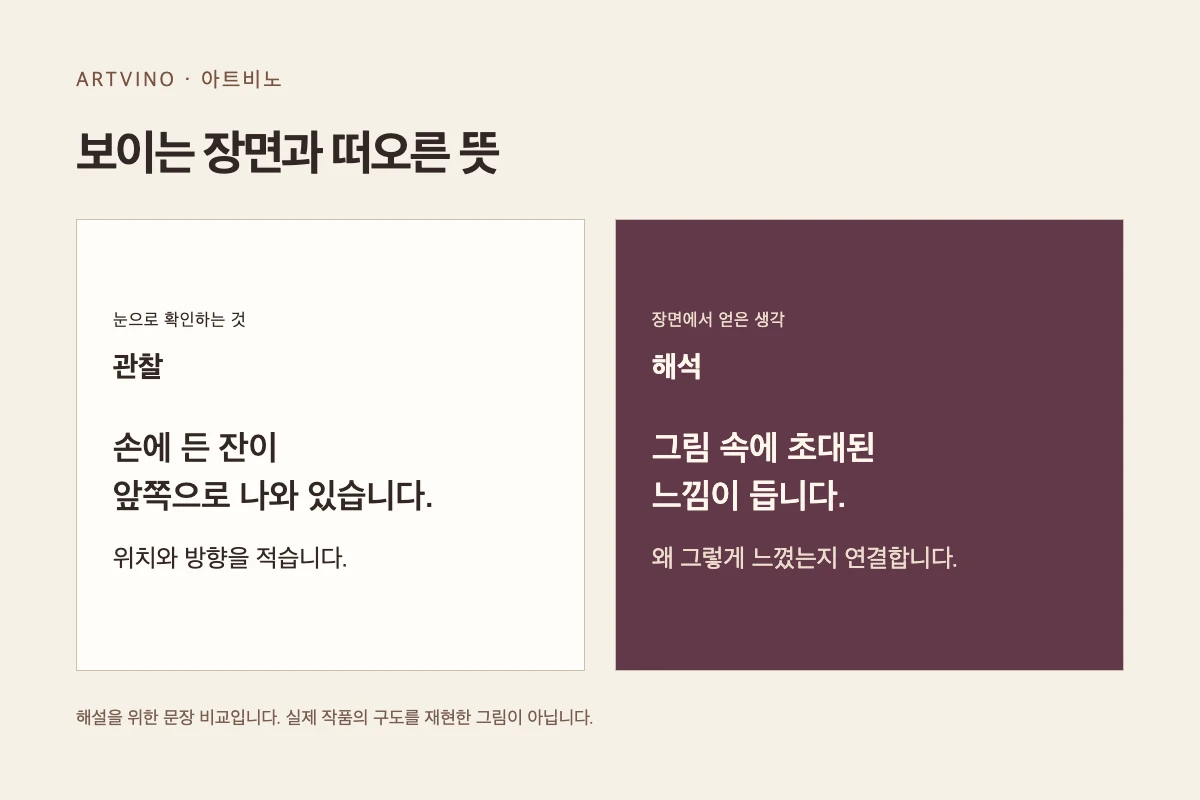
Two sentences can be enough for a short note on a painting. Saying that the glass in the hand projects forward records its position. Saying that the viewer feels invited into the scene records a thought prompted by that position. Placing the two sentences side by side makes it possible to discuss how another person’s reading of the same painting differs.
Do not carry the same interpretation straight over to glasses in other works. An empty glass in a corner of a table and a glass held by a figure occupy different places. Check the work’s title and period, then start again with the arrangement you can actually see. You do not need experience of drinking alcohol to look at drinking scenes from history. Reading the gestures and objects in a painting is enough.
Notes
- You can see the actual work on the Uffizi collection page in the references. The explanatory diagram is not a reproduction of the original.
Sources
Sources consulted for this article.