
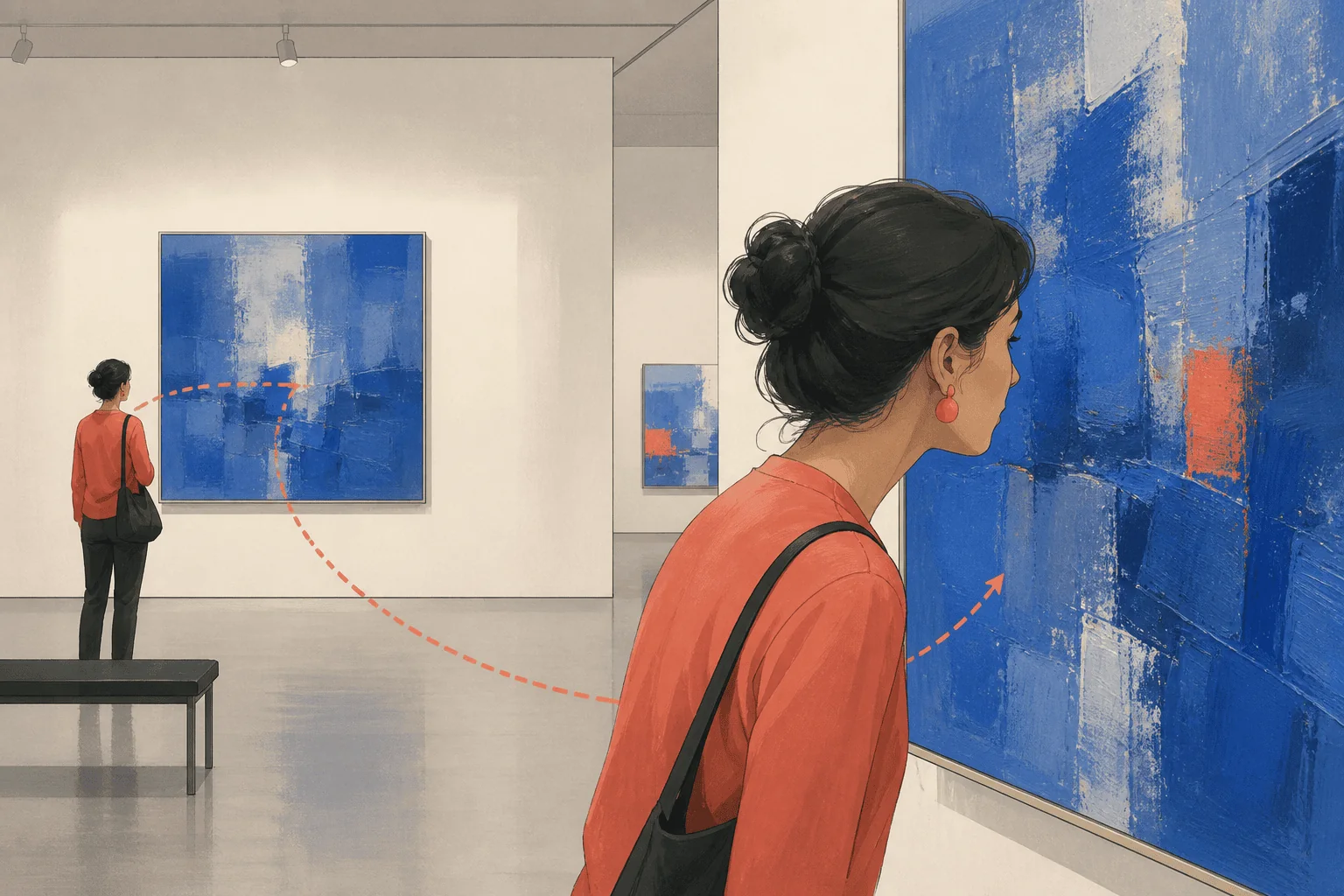
When you go to a museum, you often read the wall text before you truly look at the painting. After checking the artist name and year of creation, you look at the painting for just a few seconds and move to the next room. It is not because you lack knowledge; it is because you have not set an order for what to look at.
Key point Before interpreting a painting through facts, if you first observe in this order—broadly, slowly, and closely—you will see more and remember it longer.
What to notice
- Look at the painting for more than 30 seconds before reading the wall text.
- Follow where your eyes go first, and then the path your eyes take.
- Start by reading what you can see directly: bright and dark areas, color temperature, and brushstroke direction.
First, step back and see the whole image
Before approaching, step back two or three steps. First notice whether the canvas feels bright or dark, where its weight leans, and where the gaze settles. If you capture the overall impression before checking details, what you discover later will connect rather than scatter.
At this point, you do not need to label what was painted. Instead of asking whether it is a portrait or a landscape, look at how the large lines and masses crossing the surface are arranged.
Follow the order your eyes take
Most paintings have a point that first catches the eye. The brightest area, the most saturated color, or a face and hand are often those spots. If you slowly follow where your eyes move next, you can see the painter’s intended line of attention.
If your gaze keeps staying in one place, ask yourself why. Even noticing whether that place is brighter than its surroundings or whether nearby lines guide your eye becomes a practice in reading composition.
Move closer to see materials and brushwork
When you have looked enough, move closer. Check whether the paint was layered thickly or applied thinly, whether brush marks remain, and whether the surface has been smoothed away. Even the same green looks completely different when an area was filled in one sweep versus stacked with multiple colors.
Material traces reveal how the painter used time. A hand that moved quickly and a hand that pressed and lingered are both left on the painting itself.
At the end, read the text and look again
Now read the explanatory text. After checking the title and creation context, return to the painting, and parts that were previously overlooked will look different. Knowing facts does not replace seeing; when knowledge is added after observation, the painting stays longer in memory.
After seeing one painting this way, you can view the next one with the same sequence. More than seeing many works, truly seeing one painting helps make the museum feel easier and more comfortable.
Notes
- In exhibition spaces, stay behind the guide line so you do not stand too close or touch the painting, as protection rules require.
- There is no single correct interpretation. The order in this article is just one method; find your own rhythm and sequence.
Sources
Sources consulted for this article.